
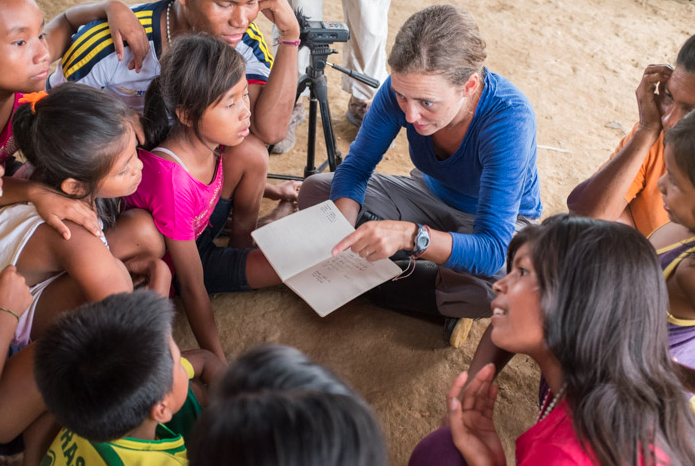
Human Interaction

January 4th, 2013

I was talking to a doctor friend the other day, telling him a story that involved a guitar player I met at Starbucks.  The doctor, a man who spends his time fixing children in hospitals, asked me how that works.  How do people with books and computers and cell phones actually meet each other in coffee shops?

It’s a good question, and not one that I would have been able to answer before moving to Chicago, which will eventually be the key to my response.

Granville Island, Vancouver

I don’t regularly make friends in the coffee shop or on the street or in the park…except when I’m traveling.
When I travel, I am 100% open to anything and anyone.  If the Ecuadorian taxi driver wants to take my boyfriend and me to the Casa del Arbol on top of our hotel’s volcano, we go.  If the local Spaniard wants to tell me every single detail about his town’s bullring, I ask more questions, just to keep him talking.  If the sweet man listening to a busker on Granville Island’s wharf wants to share the occasional glance and short observation with me, I sit patiently until he does it again.  It’s the traveler’s mentality.  Nothing is trivial and every person is an opportunity for human interaction.
I love it.

When I moved to Chicago, local friends shook their heads at me when I said, “everyone is so nice here!”  I felt silly for a moment because maybe I was missing something and Chicagoans weren’t really very nice.  All the evidence I had collected supported my case, though.

Here’s the reason, as best I can tell: I was acting like a tourist.  I was 100% open, and people responded kindly.

So, that’s my answer.  When you approach life as though you are merely a traveler, you meet nice folks in coffee shops.

Casa del Arbol on the occasionally erupting Tungurahua

Serious.

October 3rd, 2012

Every year, I make a New Year’s Resolution to take myself less seriously.

Not So Serious Headshot

New, downright unserious headshot. Click on the photo to see the rest.

Moving to Chicago has greatly challenged my resolve.  It’s hard not to become too serious when initiating and following through with great life changes.  It’s rather dramatic, all of it, and from what I’ve seen on stage and in life, when people are overly dramatic, they usually are taking themselves too seriously.

I have to be careful, because the second I start taking myself too seriously, I start taking my singing too seriously, and then it becomes an arduous, unpleasant, and therefore unfruitful task.

Fortunately, Chicago keeps throwing light and joyful music-making in my face, and it does so right when I’m starting to slip into seriousness.

John and I came across these fellows at the Chicago Jazz Festival.  Seriously good musicians, yes, but they do what I value most in artistry: they entertain themselves, and by doing so, let the audience in on the fun:

(n.b. At the Jazz Festival, Matt Wilson kept the bubble business going for a long time…and it was a cool day…and the sun came out on his very last go-around of the Carl Sandburg poem:“Two bubbles found they had rainbows on their curves. They flickered out saying: ’It was worth being a bubble, just to have held that rainbow thirty seconds.’”)

We caught the Hector Del Curto Tango Trio set during the week of Chicago’s World Music Festival.  This time: serious musicians playing rather serious and intense music, but the entire program was approached with friendly ease.  The rare bit of serious banter ended in laughter.  What balance!

That concert inspired me to attend my first night of Argentine Tango dancing in Chicago.  I was a little apprehensive: tango dancers can be very serious.  Fortunately for me, the folks I met at the Milonga Cielo were game for playing on the dance floor.  Serious dancers, yes, but permission to cause or enjoy the occasional giggle?  Yes.  Thank goodness.

It all started in the Barn at Pickathon this year.  I knew I was moving, and was feeling pretty dramatic about the whole thing, until I watched Bruce Molsky have some good, ole fashioned musical fun with a collection of seemingly mismatched musicians.  I’m a fan of Bruce Molsky’s because of his musicianship and the sparkle in his eyes, yes, but also because he told those of us in the Workshop Barn last year that he wanted to take lessons as a kid after a teaching artist visited his school in the Bronx.  I’m a teaching artist.  I like to know we can make an impact.  But back to my point: how can anyone be too serious when there’s a pink boa on stage?

Camp

July 23rd, 2012

I didn’t go to away-camp as a kid.  I had enough brothers around to terrorize me, take me to swim lessons and choir practice, and convince me to go hang out with the neighbor girl, all of which kept me adequately occupied.  It was awesome.  And most importantly: it wasn’t school.

Now that I’m big, I find myself seeking out away-camp and, yes, school.  This morning, in between singing and hearing other people sing, I listened to early music soprano Ellen Hargis talk about rhetoric.  Oh, and in Vancouver.  It was delightful.  We’re going to talk more about it and other lofty ideals later in the week.  I can’t wait.  I’m staying in a dorm and bought a plastic bowl and plate for $2 at the Safeway so I could eat my cheese sandwiches and yogurt in the shared kitchen.  I guess years and perspective have made these once tedious rituals a delight.  I will get homesick and long for my iron skillet and fresh herbs, but by then my 2 weeks at the Vancouver Early Music Vocal Programme will be nearly over and I’ll be off to my next adventure: moving to Chicago.

Away-camp lets our multi-tasking minds be singularly focused for awhile.  I guess it’s like a sabbatical.  It takes a couple of days to shed the other voices: “Where ARE you going to live when you move to Chicago?  Should you start job searching immediately?  Email folks about auditions?  When are you going to arrange that promised 45-minute Ring for UAO?”  Once those voices start slipping away, though, I figure they leave behind some space in our heads.

After a long and busy, busy semester, it’ll be nice to just think about one thing.  I feel more room in my brain already.

Can-Can flurry
One of the things occupying my brain this semester:
Valencienne’s Can-Can in Merry Widow at Muddy River Opera

Practice makes truth

April 12th, 2012

My brother Tim and I have been talking about running lately, partially because my book club just read “Born to Run.”  Tim’s a fan of the book.  I am now, too.   The conversations also are happening because Tim has taken to snapping pictures on his runs in the Pacific Northwest.  He is a photographer, so these are not your average look-at-this-cool-leaf photos.  I like that each of his running stories has a different angle.  That’s the thing about running–so many angles to offer.  Of course, it helps to have a top notch visual artist interpreting those angles.

My voice students have been hearing me quote my singing interpretation of “Born to Run” the last few weeks:  Practice being confident.  Practice telling stories.  Practice believing that singing is easy.  Practice those for long enough, and you’ll forget you’re practicing.

“Lesson two,” Caballo called.  ”Think Easy, Light, Smooth, and Fast.  You start with easy, because if that’s all you get, that’s not so bad.  Then work on light.  Make it effortless, like you don’t give a shit how high the hill is or how far you’ve got to go.  When you’ve practiced that  so long that you forget you’re practicing, you work on making it smoooooooth.  You won’t have to worry about the last one–you get those, and you’ll be fast.” (Born to Run, Christopher McDougall, page 111)

Say it again

March 15th, 2012
My friend who is pregnant for the first time excitedly told me a few weeks ago that she’s experiencing everything in a new way. I was kind of jealous.  It’s fun to experience life differently.  I think it wards off complacency.  With the coming Spring and my artistic pursuits, though, I guess I shouldn’t be jealous.  As it turns out, I’ve been noticing things too.

Actors and directors are always talking about listening, which is funny because half the time conductors are telling you NOT to listen.  If you do, you’re likely to fall behind the orchestra and the music falls apart and the conductor makes faces.  In non-singing theatre, in order to really engage on stage, you need to be listening to your scene partners and let your lines fall naturally.  Acting 101.  Well, I swear I’ve been listening, but every once in a while, I hear something I’ve heard a million times in a completely new way.  Like a pregnant lady, I guess, without the expectation.

We performed The Glass Menagerie last Friday for about 100 high school students.  I’m playing Laura.  As a few of the lines came out of our mouths, I felt the profundity of them for the first time: “Say, you finished high school?” my Gentleman Caller asked.  ”I made bad grades on my final exams,” I said.  ”You mean you dropped out?”  I stopped, “I never went back.”  Wham.  Tennessee Williams wants you all to stay in school.  Did you hear that, students?  Oh, I hope they heard it the way I did that day.

I’ve been listening differently, too, in the context of the various projects I’ve been working on simultaneously.  Some Union Avenue Opera folks and I were at an elementary school performing Little Red Riding Hood the other day, and as we started singing, I realized that Little Red’s mother says a lot of the same things that Laura’s mom says in The Glass Menagerie.  Fortunately for her, Little Red makes out better than poor Laura.  And every time the Gentleman Caller tells Laura that “being different is nothing to be ashamed of,” I think of sweet, sweet Ferdinand who discovers the very same thing in UAO’s other children’s opera, Carmen and the Bull.  He makes out better than her, too.

My parents heard my brother sing with the Atlanta Symphony Chorus last weekend.  It was Bach.  They  found it fascinating that Bach would write an aria that lasts 8 minutes, but only has 2 lines of text.  Why sing the same 2 lines over and over again for 8 minutes?

Maybe Bach wants us to sing and hear the same words in a new way each time, too.

See how the glass shines?
The Glass Menagerie at Insight Theatre Company. Photo © John Lamb.

Like mother, Like daughter

December 16th, 2011

Growing up, my dad referred to my mom as The Wicked Witch.  It wasn’t because she was mean or green.  Nope.  It was, quite simply, her Halloween costume one year.  Maybe she should have stuck with something bolder, like Super Woman…or perhaps gentler, like Snow White or Rainbow Brite.  Really, anything that didn’t have anything to do with a witch.  Alas, she did not have that foresight, and the nickname stuck.  So did the melting jokes.

A few years ago, everyone in my parents’ office filled out questionnaires.  It was a game.  They anonymously answered questions about themselves and then everyone else had to guess the identity of the question-answerer: one of the office-place-community-development-fun-interactive-morale-boosters they enjoy.   One of the questions asked was, “Which actress would play you in a movie about your life?”  My mom had a hard time with that one.  I told her it was obvious: she’s a prettier version of Susan Sarandon.

I went to an audition a few weeks ago, and when I was finished with my song and aria, the auditor asked for a monologue.  I told her I had a few to choose from, and she excitedly asked for the Wicked Witch’s “Poppies” monologue from The Wizard of Oz.  When I finished, she said, “Has anyone ever told you you look like Susan Sarandon?”

My first thought was, “Wow, that’s nice.”  My second was, “Does that mean you’ll hire me?”  The third was, “Wait ’til I tell the Wicked Witch.”

Dorothy landed a house
My version of the Wicked Witch this year in the Variety Children’s Theatre’s production of The Wizard of Oz.